How To Understand Your Best-Selling Products Using KarryBiz Analytics

Every seller has a gut feeling about which products are doing well, especially for products that get frequent enquiries. Or those products you shipped out recently. You notice these things and over time, you develop a sense of what is working in your store.
But here is the problem with gut feelings: they are selective or preceptive. They remember the dramatic moments: the product that sold out overnight, the customer who raved about a specific item — but they miss the quieter, consistent patterns that are often more valuable.
The product that sells two or three units every single week without drama or fanfare. The item that never runs out because you always keep it stocked — but you never noticed it is actually your most reliable revenue generator. The category that quietly accounts for 60% of your monthly revenue while you have been pouring marketing energy into the flashier category that only contributes 15%.
These patterns are nearly invisible to the naked eye or often missed especially that we are subjected to perception. But these vital signals are completely visible in your data.
And that is exactly what the Top Performing Products section of KarryBiz’s Business Analytics dashboard is built to show you.
In this guide, we are going to go deep on how to use this feature — not just to see which products are selling, but to understand why they are selling, what to do with that information, and how to use your bestseller data to make decisions that compound into real business growth.
Why Knowing Your Bestsellers Changes How You Run Your Business
Before we get into the how, let us talk about why this matters so much. A lot of sellers check their analytics, see their top products, go “oh interesting”, and then do nothing different. That is not what we are here for.
Understanding your bestselling products is actionable intelligence. Here is specifically what it changes:
• It Tells You Where to Put Your Money:
Inventory investment is a finite resource. Every naira you spend stocking a slow-moving product is a naira that can’t be invested in a fast-moving one.
When you leverage real data and understand which products sell most reliably, you can allocate your restocking budget with confidence. More money into winners. Less money into products that sit long.
• It Shows You Where to Focus Your Marketing:
Most sellers market everything equally — the same WhatsApp status post for every product, the same energy promoting a bestseller as a product nobody is interested in.
Your bestsellers deserve disproportionate marketing attention. Not because other products don’t matter, but because promoting proven winners has the highest return on your marketing effort. A product that already sells well will sell even better when you actively push it. A product that barely moves rarely becomes a bestseller just because you promoted it harder.
• It Reveals What Your Customers Actually Want:
The thing about bestsellers is that they are not random. Customers buy them for reasons. Maybe it solves a specific problem particularly well. Maybe it is priced exactly right for your audience. Maybe it is the item your most loyal customers keep coming back for.
Understanding your bestsellers is understanding your customers; what they value, what they are willing to pay for. And what keeps them coming back. That understanding guides every future product decision you make.
• It Identifies Opportunities To Expand:
Your top-performing products are market signals. If customers are repeatedly buying a specific type of product from you, they are telling you they want more of that category. Your bestseller is a conversation — and the right response is to give your customers more of what they have already shown they love.
Where To Find The Top Performing Products Data on KarryBiz
Step 1: Log In and Navigate to Analytics
Open the KarryBiz app and log in to your account.
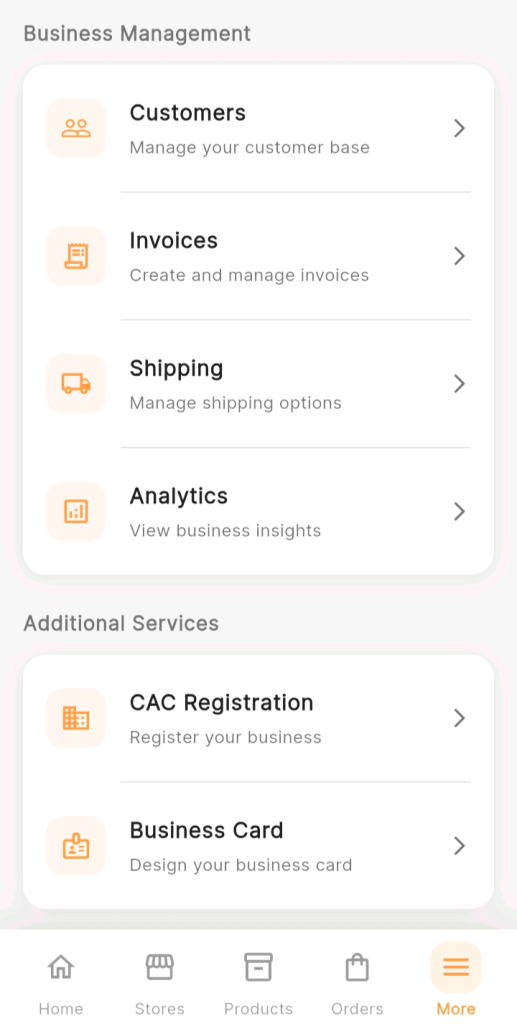
From the bottom navigation bar, tap “More.”
Under the Business Management section, tap “Analytics” — View business insights.
The Business Analytics page opens.
Step 2: Set Your Time Period
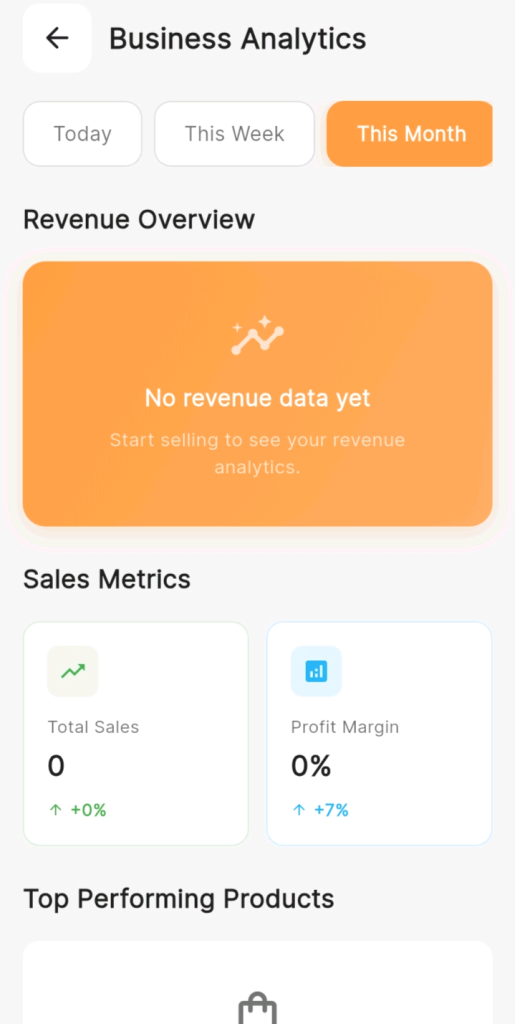
At the top of the Business Analytics page, you will see three time filter buttons:
• Today.
• This Week.
• This Month (default).
For analyzing your bestselling products, This Month is your primary view — it gives you enough data to identify meaningful patterns without being so long-term that recent changes in your product range are obscured.
However, do not ignore the other time periods. Each tells a different part of the story.
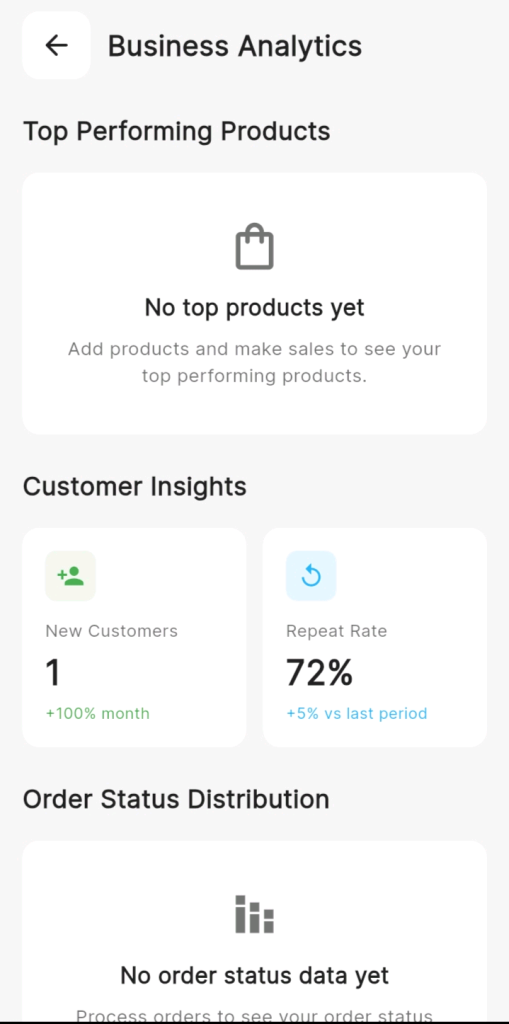
Step 3: Scroll to the Top Performing Products Section
Scroll past the Revenue Overview and Sales Metrics sections to reach Top Performing Products.
This section displays a ranked list of your best-selling products for the selected time period — showing which items have generated the most sales or revenue during that window.
Step 4: Read Your Top Performing Products List
Once you have sales data, the Top Performing Products section shows your products ranked by performance — typically displaying:
• Product name: The specific item.
• Number of units sold: How many have been purchased in the selected period.
• Revenue generated: The total naira value of sales for that product.
• Ranking position: Which product sits at number 1, 2, 3, and so on.
Step 5: Cross-Reference With Sales Metrics
Your Top Performing Products data doesn’t live in isolation. It tells its most complete story when you read it alongside the other sections of your analytics dashboard.
Final Thoughts
Your customers are already telling you what they want. They are telling you with their orders. They are indirectly voting with their wallets, every single day — for specific products in your store.
The Top Performing Products section of your KarryBiz analytics dashboard is where those votes are counted.
The sellers who look at this data regularly and who actually do something with it — build stores that feel effortlessly well-stocked, perfectly priced, and magically relevant to every customer who visits.
The truth is there is nothing magical about it. It is just data, applied consistently. Apply these data and take charge of your business.