How To Set Shipping Zones For Different Locations On KarryBiz

Here is a question worth sitting with for a moment.
If a customer in Lagos and a customer in Kano both order from your KarryBiz store — should they pay the same delivery fee?Of course not. Delivering to Lagos Island from Ikeja costs a fraction of what it costs to ship a package to Kano. The logistics are different. The carrier options are different. The timeframes are different. The costs to you as a seller are fundamentally different.
And yet — many online sellers set up one generic shipping option and apply it to every customer regardless of where they live. Sometimes they undercharge Lagos customers and cover the difference from their margins. Sometimes they overcharge Kano customers and wonder why they get fewer orders from the north. Sometimes they just pick a middle ground that is wrong for almost everyone.
This is a shipping zone problem. And it has a clean, practical solution built right into KarryBiz.
Shipping zones are the practice of creating different delivery options for different geographic locations — with prices and timeframes that accurately reflect the actual cost and logistics of delivering to each area. Done well, they let you serve customers across Nigeria fairly and profitably — Lagos buyers pay Lagos rates, Abuja buyers pay Abuja rates, and everyone understands exactly what to expect before they order.
In this guide, we will go deep on how to set up shipping zones properly on KarryBiz — which locations to create, and the strategy behind building a shipping structure that works for both your customers and your business.
What Are Shipping Zones and Why Do They Matter?
A shipping zone is simply a defined geographic area with its own delivery pricing and terms.
Instead of one universal shipping rate that is either too high for close customers or too low for distant ones — shipping zones let you create a menu of delivery options, each tailored to the reality of delivering to that specific area.
Why this matters for your KarryBiz store:
• It Makes Your Pricing Fair and Accurate:
Lagos customers shouldn’t subsidize Kano deliveries. And Kano customers shouldn’t be overcharged because you used Lagos rates as your baseline. Zone-based pricing reflects actual logistics costs — which is fair for everyone.
• It Expands Your Serviceable Market:
Many sellers restrict themselves to Lagos because they are afraid of the complexity of nationwide delivery. But with clear zone-based rates, nationwide delivery becomes manageable and profitable. You know exactly what each zone costs and can price accordingly.
• It Reduces Customer Confusion:
When a buyer from Abuja sees a dedicated “Abuja Delivery” option with a clear price and timeframe — they know immediately that you serve them and what it will cost. No guessing and no messaging to ask. No cart abandonment from uncertainty either.
• It Protects Your Margins:
Shipping costs are often the hidden margin killer for online sellers. By pricing each zone accurately — neither subsidizing nor overcharging — you protect your profitability across every delivery location.
• It Builds Professional Credibility:
A store with thoughtfully structured delivery zones looks like a serious, organized operation. It signals that you have invested in understanding your customers’ geography and your own logistics — not just thrown up a generic “delivery available” note.
Step-by-Step: How to Set Up Shipping Zones on KarryBiz
Now that you understand the zones conceptually — let’s build them in the app.
Step 1: Log In and Navigate to Shipping
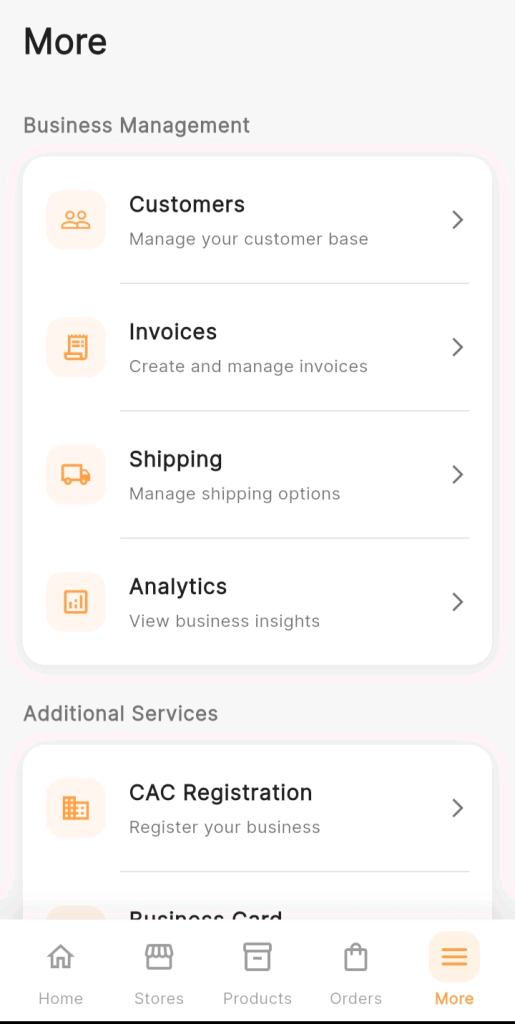
Open the KarryBiz app and log in to your account.
From the bottom navigation bar, tap “More.”
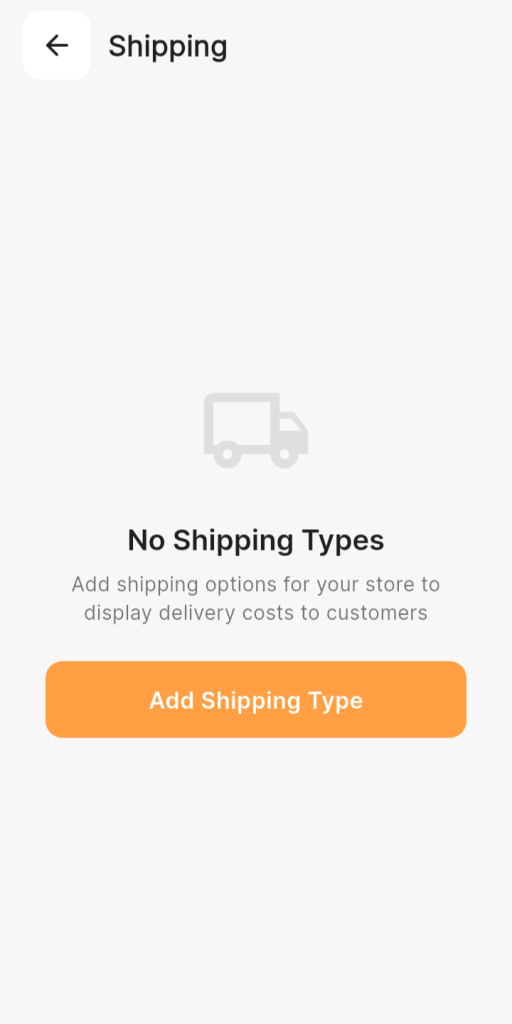
Under the Business Management section, tap “Shipping” — Manage shipping options.
Step 2: Plan Your Zone Structure Before You Build
Before tapping “Add Shipping Type” — spend five minutes mapping out your zone structure on paper or in a note on your phone.
Ask yourself:
• Where is the majority of my current customer base located?
• Which locations have I delivered to in the past — and what did it cost me?
• Do I want to offer nationwide delivery, or focus on specific regions?
• Do I have any locations where I want to offer free shipping as a strategy?
• Are there any locations I’m not able to serve — and should those be excluded?
Step 3: Create Your First Shipping Zone
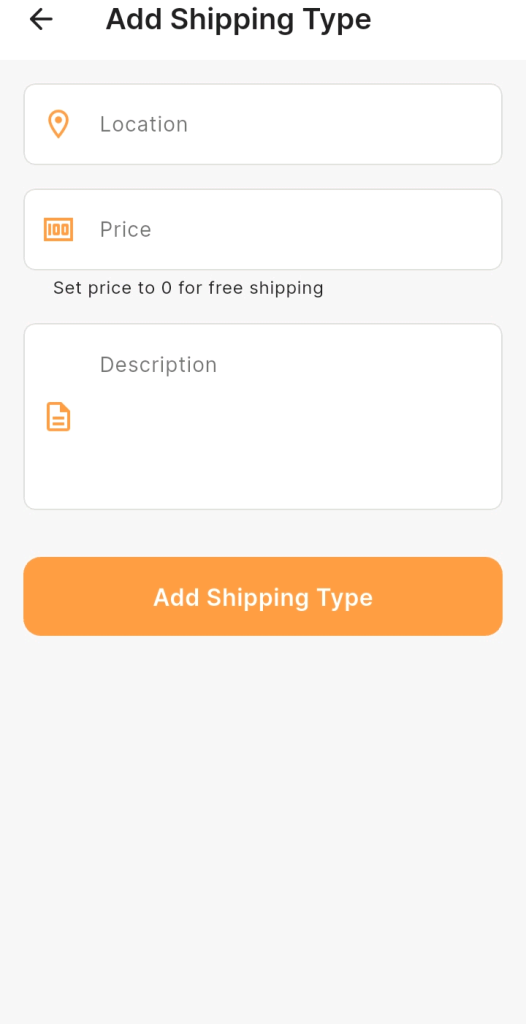
Tap “Add Shipping Type” to open the Add Shipping Type form.
The form has three fields:
• Location (pin icon).
• Price (currency icon).
• Description (document icon).
And the orange “Add Shipping Type” button to save.
Step 4: Review Your Complete Shipping Zone Structure
After adding all your zones, return to the Shipping page (More -> Shipping) to see your complete list of shipping types.
Review the full list and ask yourself:
• Does every zone I actually deliver to have a shipping option?
• Are the prices accurate — covering my costs with an appropriate margin?
• Are the descriptions clear enough for customers to self-select the right option?
• Is there a free shipping tier to encourage larger orders?
• Are there any locations I have accidentally left uncovered?
• Are there any zones that overlap confusingly — like a “Lagos” zone and a “Southwest” zone that both include Lagos?
Step 5: Test Your Shipping Zones as a Customer
The final step before going live is testing.
Copy your KarryBiz store link (e.g. karry.biz/yourstorename) and open it in a browser — ideally in an incognito window so you are viewing it as a new customer would. Browse a product. Proceed toward checkout.
Check:
• Are your shipping zones visible and clearly presented?
• Are the zone names descriptive enough that a customer can immediately identify which one applies to them?
• Are the prices displaying correctly?
• Does the free shipping option show ₦0?
• Is the description text clear and free of errors?
Note: If anything looks wrong or confusing — go back to More -> Shipping, find the relevant zone, edit it, and test again.
Final Thoughts
Shipping zones are one of those things that feel like admin — until you realize they are actually strategy.
A well-structured set of shipping zones tells every customer — wherever they are in Nigeria — that your store sees them, serves them, and has thought about what delivery looks like in their specific location. That is a powerful message. It says: we are not just a Lagos store. We are a national brand that happens to be based in Lagos.
And the practical effects are real. Fewer abandoned carts from delivery uncertainty. Better margin protection from accurate zone pricing. Higher average order values from strategic free shipping thresholds. More orders from outside your immediate city from customers who now know — clearly and confidently — that you deliver to them.
Open your KarryBiz app. Tap More. Tap Shipping. Build your zones.
Because every customer in every state who wants what you sell deserves a delivery option that makes sense for where they are.